How to Read Your Bank Statement (NZ Guide)
What does 'EFTPOS AUTH' actually mean on your bank statement? Decode every NZ transaction code, fee, and abbreviation, from AP to DD to PIE tax.
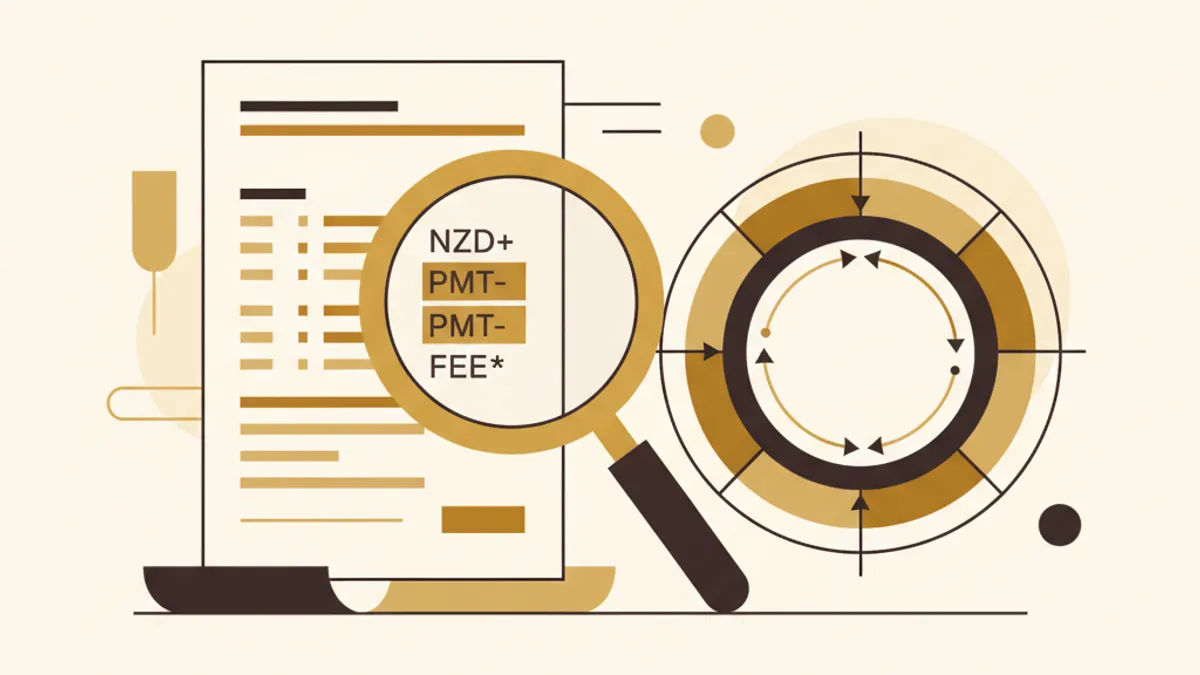
The short version
- Your bank statement shows every transaction in and out of your account for a specific period.
- Any card payment at a physical terminal. "POS TXN WOOLWORTHS RICCARTON" means you tapped your card at Woolworths in Riccarton.
- If you see a transaction you don't recognise, contact your bank immediately.
Bank statements look like a foreign language. "POS TXN", "D/D", "ATM W/D", what does it all mean? Understanding your statements is the first step to tracking your spending.
Here's your guide to reading a NZ bank statement like a pro.
The basics
Your bank statement shows every transaction in and out of your account for a specific period. Most NZ banks provide statements monthly, and you can view them in your banking app or download a PDF.
Key columns
- Date, when the transaction was processed (not necessarily when you made it)
- Description, the merchant, reference, or type of transaction
- Debit, money going out (spending, transfers, payments)
- Credit, money coming in (salary, transfers, refunds)
- Balance, your running total after each transaction
Common NZ transaction codes
POS (Point of Sale)
Any card payment at a physical terminal. "POS TXN WOOLWORTHS RICCARTON" means you tapped your card at Woolworths in Riccarton.
D/D (Direct Debit)
Automatic payments set up by a company to take money from your account. Power bills, phone plans, insurance, these are all D/D.
A/P (Automatic Payment)
Payments you've set up yourself to go out automatically. Rent, savings transfers, loan payments.
ATM W/D (ATM Withdrawal)
Cash withdrawn from an ATM. The location is usually shown.
TFR (Transfer)
Money moved between your own accounts or to someone else.
INT (Interest)
Interest earned on your account (credit) or charged on your overdraft (debit).
FEE
Bank charges, monthly account fees, transaction fees, dishonour fees.
Spotting problems
Unauthorised transactions
If you see a transaction you don't recognise, contact your bank immediately. NZ banks have fraud protection and will investigate.
Double charges
Sometimes a merchant charges you twice. Check for identical amounts on the same day. Contact the merchant first, then your bank if they don't resolve it.
Unexpected fees
Check for fees you didn't expect, overdraft charges, international transaction fees, or monthly account fees. You may be on the wrong account type. Compare NZ bank accounts to find a better fit.
Steady tip: Steady auto-categorises all your transactions and flags unusual patterns. Instead of reading through bank statements manually, you can ask the AI "Were there any unusual charges this month?" and get an instant answer.
Why does my bank balance not match my statement?
Because they are measuring two different moments. A statement covers a closed period. Your balance is right now.
The other half of the gap is pending transactions. A card payment can sit as pending for a day or three before it posts, so your available balance has already dropped while the statement has not caught up.
Treat the statement as the record and the available balance as the warning. The difference is money you have spent but have not been charged for yet.
What is a pending transaction?
A payment your bank knows about but has not finished processing. The merchant has reserved the money; the transfer has not settled.
Most clear within one to three working days. Some reserve more than the final amount and refund the difference later, which is why a petrol stop or a hotel booking can look wrong for a few days.
Pending amounts are the most common reason a balance looks off. Nothing has gone missing. It is in transit.
Why is the date on a transaction different from the day I paid?
Statements show the processing date, not the moment you tapped your card.
Saturday morning coffee usually processes on the Monday, because banks batch payments on working days. A public holiday pushes it out further. That is why a weekend of spending often lands as one dense Monday.
It matters when you are checking whether something arrived before a bill went out. Work from the processing date, not your memory of the day.
How many months of bank statements do I need for a loan or a rental?
Three months is the usual ask in New Zealand, from lenders and property managers alike.
They are reading for stability rather than perfection: income arriving regularly, rent or board paid on time, and no run of dishonour fees. One overdrawn day rarely matters. A pattern of them does.
If you know an application is coming, three tidy months is a realistic target, and it is the one piece of homework you can actually do in advance.
Making statements useful
Reading bank statements is important but tedious. The modern approach is to let an app do it for you. Steady connects to your bank via open banking and turns that wall of transaction codes into a clear spending breakdown, by category, over time, with trends and insights.
No more squinting at "POS TXN" codes. Just clear answers about where your money goes. See how Steady works.

Written by Sam Wilson
Founder, Steady
Sam is a New Zealand founder building Steady, a personal finance app designed for Kiwis, integrated with every major NZ bank via Akahu. He writes about money, bank integrations, and what actually works for everyday New Zealanders.More about Sam
Steady connects your bank and tracks it all automatically, no spreadsheets. Join the waitlist for early access.
Suggested reads
More from the Steady blog
How to Track Spending Automatically in NZ (2026 Guide)
Still entering transactions by hand? How to connect your NZ bank, what two years of history gets you, and how often the data actually refreshes.
How to Start Budgeting in NZ: Beginner's Guide (2026)
Forget spreadsheets. This 10-minute guide gets you a working budget that actually fits NZ pay cycles, fortnightly or weekly. Free template inside.

What Is Open Banking and Why Should NZ Care?
Open banking just landed in NZ, and it changes everything about how you manage money. Is your bank data safe? Here's the full breakdown.
Ready to sort your money?
Steady connects to your NZ bank accounts and helps you track spending, set goals, and get AI-powered insights.
Try Steady free