12 Ways NZers Are Cutting $500/Year Off Their Power Bill
Twelve tested strategies to drop your NZ power bill by hundreds, without freezing through winter. Real savings, ranked by effort.
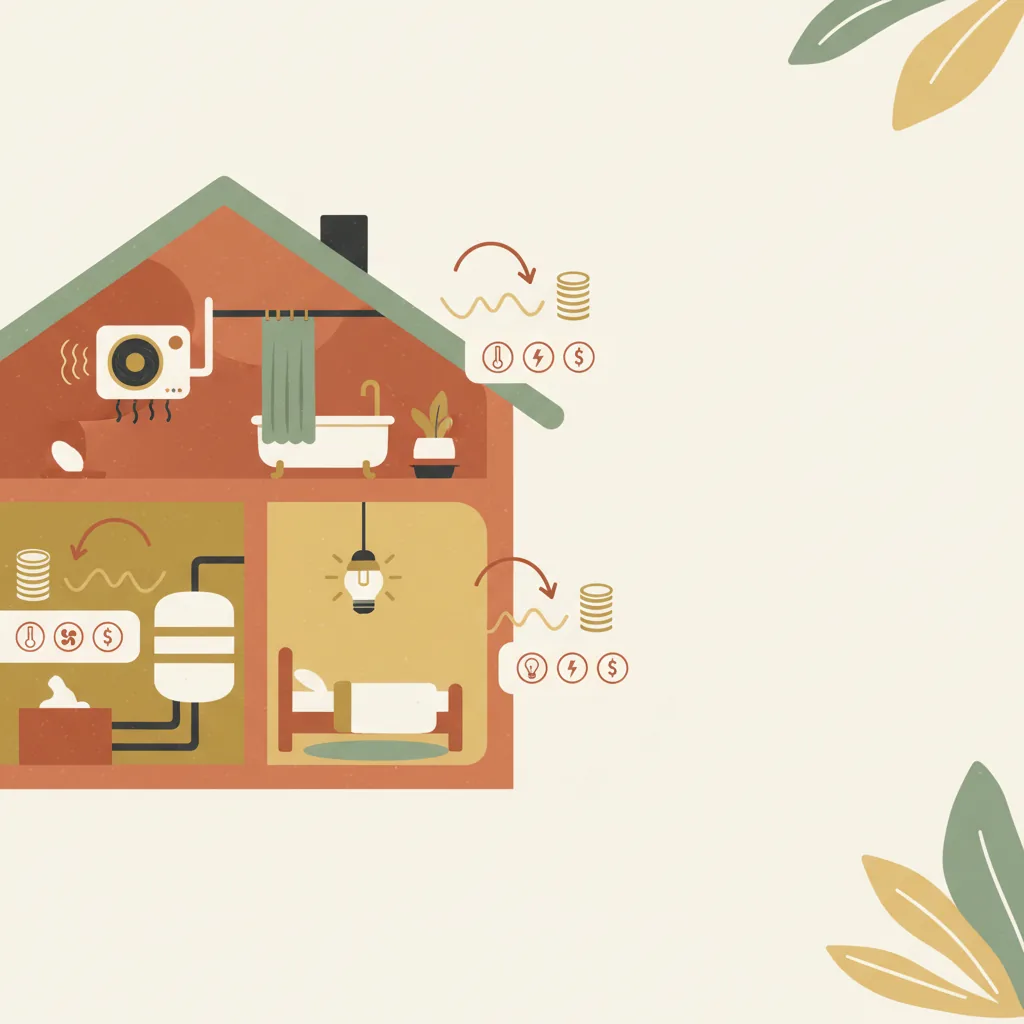
The short version
- If you still have any old bulbs in your home, replace them.
- If your home was built before 1978 and hasn't been retro-insulated, EECA Warmer Kiwi Homes subsidises ceiling and underfloor insulation up to 90%.
- The "vampire load", devices using power while "off", is typically 5-10% of an NZ home's bill.
NZ households spend roughly $2,200/year on power in 2026, more if you live in an old wooden villa with a gas hot water system, less if you live in a small apartment. The good news: most homes have $300-$700 of yearly fat that can come out without freezing through winter.
Here are 12 strategies, ranked by effort vs return.
Quick wins (15 minutes, $100-$300/year)
1. Switch power companies
The single highest-leverage move. Most Kiwis have been with the same power company for 5+ years. New customer rates are almost always better than loyalty rates.
Use PowerSwitch (consumer.org.nz/powerswitch), enter your address and last bill details, get a free comparison. Switching takes 10-30 days and you don't lose power during the changeover.
Realistic saving: $200-$500/year
2. Move your hot water cylinder to overnight rate
If you're on a time-of-use plan (Mercury Day-Night, Contact Time of Use, Frank Energy Off-Peak, etc.), your night-time rate is typically 30-50% cheaper than peak. Set your cylinder to heat overnight only.
Most cylinders have a relay switch that can be controlled by an external timer. A $30 mechanical timer at Mitre10 pays for itself in two weeks.
Realistic saving: $150-$300/year
3. Audit your thermostat habits
If you heat to 22°C, you're paying for it. Health-NZ recommends 18-20°C in living rooms. Each degree higher = roughly 10% more heating power.
Setting heat pumps to 19°C in winter (instead of 22°C) cuts winter heating cost by 25-30%.
Realistic saving: $100-$200/year
Medium-effort wins (one weekend, $200-$500/year)
4. Replace incandescent and halogen bulbs with LEDs
If you still have any old bulbs in your home, replace them. LEDs use 80-90% less power and last 10-25 years.
Quick maths: a 60W incandescent bulb running 4 hours/day costs ~$28/year in power. An equivalent LED costs ~$3/year. Replace 8 bulbs and you save $200/year, for a one-off $40 cost.
Realistic saving: $150-$250/year
5. Stop heating empty rooms
If your house has bedroom heaters running while everyone's at work or asleep elsewhere, you're paying for nothing. Programmable heat pumps + smart plugs cost <$100 and pay back within months.
Even simpler: turn off heaters in rooms you're not in. Yes, the room takes 30 minutes to warm up later, but heating an empty room costs more than reheating it once.
Realistic saving: $100-$300/year
6. Shorter showers
The average NZ shower uses ~10L/minute. An 8-minute shower in a gas-heated home costs ~$1. A 5-minute shower costs ~62¢. A two-person household saving 6 minutes a day = ~$130/year.
Free fix: a $4 sand-timer for the shower. Works.
Realistic saving: $100-$200/year
7. Wash clothes in cold water
Modern detergents work fine in cold water. Heating water for washing can be 80% of the machine's energy use. Switching from warm to cold for normal loads cuts a typical household's washing-machine power by 70%.
Realistic saving: $40-$80/year
High-leverage but bigger investment
8. Insulate properly
If your home was built before 1978 and hasn't been retro-insulated, EECA Warmer Kiwi Homes subsidises ceiling and underfloor insulation up to 90%. For most homes you pay $200-$500 for $3,000+ of insulation.
Insulating a previously-uninsulated home cuts heating costs 30-40%.
Realistic saving: $400-$800/year
9. Switch to a heat pump
If you're heating with electric heaters, a heat pump uses 1/3 the power for the same output. EECA also subsidises heat pumps for some households.
The break-even on a $3,000 heat pump installation is typically 4-6 years vs running standard heaters. After that it's pure savings for another decade.
Realistic saving: $300-$600/year
10. Hot water cylinder upgrade or wrap
Old uninsulated hot water cylinders lose heat constantly. A $30 cylinder wrap from Bunnings cuts standby loss by 40%. A new energy-efficient cylinder (or a heat-pump hot water system, if you can afford it) drops hot-water costs by 50-70%.
Realistic saving: $80-$300/year (wrap) / $300-$500/year (full upgrade)
Behaviour changes (free, $100-$200/year)
11. Standby power audit
The "vampire load", devices using power while "off", is typically 5-10% of an NZ home's bill. Set top boxes, gaming consoles, microwaves, kettles, and anything with a clock are the worst offenders.
Solution: power strips with switches. Turn off the strip when not in use. Or unplug.
Realistic saving: $50-$150/year
12. Stop using the dryer
Clothes dryers are the second-biggest power hog in most homes (after hot water). NZ has a windy climate, line drying works most of the year. Even a covered porch in winter is faster than people think.
If you must use the dryer, run it on a load sensor setting (auto-stops when clothes are dry) instead of a fixed timer.
Realistic saving: $80-$200/year
Putting it together
Pick three to start with. The biggest mistake is trying to do all 12 at once and burning out by week three.
For most NZ households, the highest-impact combo is:
- Switch power companies (#1), biggest single saving
- Move hot water to overnight (#2), easy if you have time-of-use
- Audit thermostat / heat pump habits (#3), costs nothing
That trio alone saves $500-$1,000/year for the average household. Add the LED swap (#4) and you're well past $700/year.
What about solar?
Solar is a separate question we'll cover in another post. The short version: it works in NZ but the payback is 8-12 years for most homes. Worth doing if you own your home and plan to stay 10+ years; not worth doing if you're renting or moving soon.
How to track if it's working
Power bills are monthly, so you won't see results immediately. Compare your bill to the same month last year, that's the only meaningful comparison (winter vs summer skews everything).
Most NZ power retailers also show graphs in their app. Look for the kWh trend, not the dollar trend (rates change too).
---
If you connect your bank to Steady, every power bill gets categorised under "Bills" automatically. Watching the "Bills" category shrink month over month is one of the most satisfying ways to see this kind of effort actually pay off.

Written by Sam Wilson
Founder, Steady
Sam is a New Zealand founder building Steady, a personal finance app designed for Kiwis, integrated with every major NZ bank via Akahu. He writes about money, bank integrations, and what actually works for everyday New Zealanders.More about Sam
Steady connects your bank and tracks it all automatically, no spreadsheets. Join the waitlist for early access.
Suggested reads
More from the Steady blog
How to Switch Power Companies in NZ (Save $200-400/Year)
NZ households overpay $300-800/year on power. Switching takes 10 minutes and costs nothing. Here's exactly how (with the free govt tool).

🥝 12 Ways to Cut Your NZ Food Spending (Without Eating Rice)
NZ food prices are up 22% since 2022. These 12 tricks cut our test family's grocery bill by $180/month, without eating plain rice every night.

Average Grocery Bill NZ 2026: Family of 4, Couples & Singles Compared
A family of four now spends $350–$450/week on groceries in NZ. Real 2026 numbers by household size across Pak'nSave, Woolworths and New World, plus 11 ways to cut $100+/week.
Ready to sort your money?
Steady connects to your NZ bank accounts and helps you track spending, set goals, and get AI-powered insights.
Try Steady free