Afterpay vs Credit Cards in NZ: Which Actually Costs You More?
Afterpay feels free but 42% of NZ users have been hit with late fees. Here's the real cost comparison, and when BNPL makes sense vs when it doesn't.
The short version
- Let's start with the shiny new kids on the block: Afterpay, Laybuy, Humm, Zip, Genoapay, and their mates.
- This is the big one. BNPL loudly proclaims "interest-free!" while credit cards have those scary APR numbers staring you down.
- This is where BNPL providers make their money.
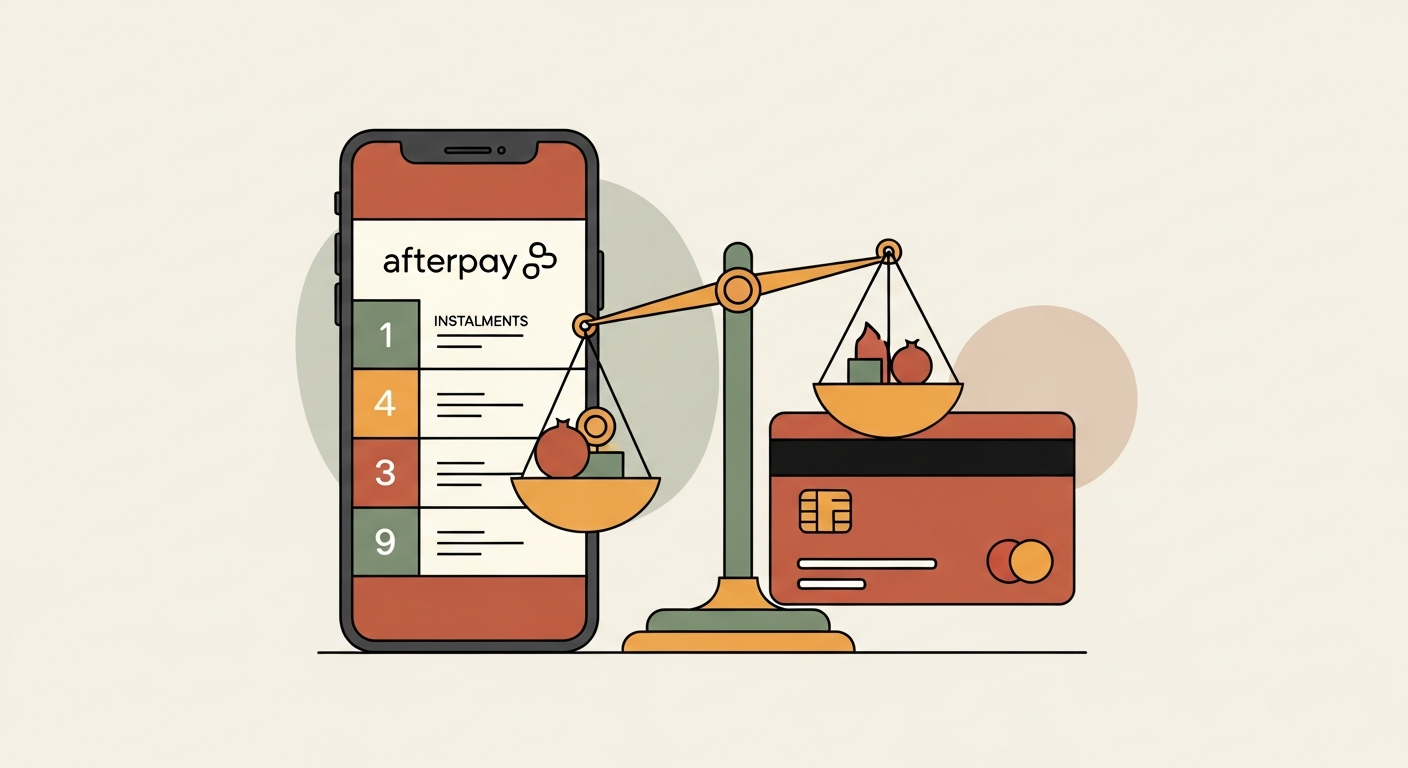
You are at the checkout with two options: "Pay in 4 interest-free instalments with Afterpay", or pay with your credit card.
Interest-free sounds like the obvious win, and the credit card sounds like the thing responsible people avoid. It is not that simple, and which one costs you more depends almost entirely on whether you pay on time.
But here's the kicker: sometimes, the thing that looks free can end up costing you a whole lot more. And sometimes, that "bad ex" credit card might actually be the lesser of two evils, if you know how to wield it.
We're not here to preach, just to lay out the cold, hard facts about Buy Now, Pay Later (BNPL) services versus the good ol' credit card here in Aotearoa. Because when it comes to your hard-earned dosh, ignorance isn't bliss – it's just expensive.
The "Buy Now, Pay Later" Hype: How Does It Work?
Let's start with the shiny new kids on the block: Afterpay, Laybuy, Humm, Zip, Genoapay, and their mates. These platforms have exploded in popularity because, on the surface, they seem like magic. You see something you want, and instead of forking out the full amount upfront, you pay a small chunk (usually 25%) immediately, and then three more equal payments every two weeks. Easy as.
The appeal is huge:
- No upfront interest: They tout themselves as "interest-free."
- Instant gratification: You get your goodies straight away.
- Easy access: Often just needs a debit card and a quick sign-up.
Merchants love them too because it encourages you to spend more, or at least, complete a purchase you might otherwise have second-guessed. The BNPL company pays the merchant upfront (minus a fee), and then they collect the money from you. Simple enough, right? The devil, as always, is in the details – specifically, what happens when those bi-weekly payments aren't quite so simple to meet.
Credit Cards: The OG Debt Machine (But Not Always)
Now, let's talk about credit cards. For decades, these plastic rectangles have been the go-to for convenient spending, big purchases, and emergency funds. But they've also earned a reputation for being debt traps, racking up high interest rates, and generally being a bit of a financial villain.
Here’s the basic gist: your bank gives you a line of credit, which you can use to buy things. You get a monthly statement, and you have two choices:
- Pay the full balance by the due date: If you do this, you pay absolutely zero interest. Zilch. Nada. Most credit cards offer an interest-free period (often 45-55 days) from the date of purchase.
- Pay only the minimum amount (or anything less than the full balance): This is where credit cards can become expensive. You'll be charged interest on the outstanding balance, and those rates can be steep, often ranging from 15% to 25% APR (Annual Percentage Rate) in NZ.
For a responsible spender, a credit card can actually be a useful financial tool, helping to build a good credit history and offering perks like rewards points or travel insurance. The problem arises when people treat their credit limit like extra income rather than a short-term loan.
The Real Cost Showdown: "Free" vs. Interest
This is the big one. BNPL loudly proclaims "interest-free!" while credit cards have those scary APR numbers staring you down. So, BNPL is always cheaper, right? Not necessarily.
Let's use an example: You buy a new pair of sneakers for $200.
Scenario 1: Using Afterpay (or similar)
- Initial payment: $50
- Next 3 payments: $50 every two weeks.
- Total paid: $200.
- Total interest: $0.
Sounds great, doesn't it? But what if you miss a payment? Afterpay's typical late fee in NZ is $10 for a missed payment, and if it's still unpaid a week later, another $7. So for those $200 sneakers, miss one payment cycle and you are paying $217. Miss two and it is $224.
Missing payments can also block future purchases. This is where BNPL catches people out: the fees add up quietly, and the interest-free purchase stops being interest-free.
Scenario 2: Using a Credit Card
- Purchase: $200
- If you pay the full $200 by the due date (e.g., within 45 days):
- Total paid: $200.
- Total interest: $0.
- If you don't pay the full balance and carry a $200 balance for, say, two months at 20% APR:
- Monthly interest on $200: Roughly $3.33 (20% of $200 divided by 12 months).
- Total interest over two months: ~$6.66.
- Total paid: $206.66.
Comparing the two: if you pay off your credit card in full and on time, it's identical to BNPL in terms of cost ($0 interest). If you fall behind on BNPL, those fixed late fees can often be higher than the interest you would accrue on a small credit card balance over a short period.
Work it through. $17 in Afterpay late fees on a $200 purchase is an effective 8.5% extra cost. Compare that to $6.66 in credit card interest over two months. Suddenly, BNPL isn't looking quite so "free."
The Late Fee Trap: Where BNPL Bites Back
This is where BNPL providers make their money. While they earn a cut from merchants, a significant portion comes from those pesky late fees. And they are designed to be easy to incur. A payment automatically debited from an account with insufficient funds, or forgetting to update card details after an expiry, and boom – $10 fee. Miss a further week and another $7, for a total of $17 on a single payment, on a single item.
Imagine you've got three BNPL purchases on the go, each with four payments spread across different dates. If you hit a tight financial patch and miss just one payment on each, you're suddenly looking at $30+ in fees, minimum. These aren't like credit card interest which compounds; they're flat fees that hit hard and fast. It's like finding a hidden tax on your "free" shopping spree.
Your Credit Score in NZ: Does BNPL Even Matter?
For a long time, the impact of BNPL on your credit score in New Zealand was a bit of a grey area. Traditional credit cards are definitely reported to credit bureaus (like Equifax and Centrix), and your payment history directly influences your credit score. Good payments = good score; missed payments = bad score.
BNPL, historically, hasn't always been reported as comprehensively. However, this is changing.
- Some BNPL providers are now sharing data: Services like Centrix are starting to incorporate BNPL payment data into credit reports. This means if you're consistently making your BNPL payments, it could positively impact your score.
- Missed payments can definitely hurt: The more significant risk is negative reporting. If you repeatedly miss BNPL payments and default on your agreements, this information will be shared with credit bureaus and can absolutely trash your credit score. This can make it harder to get a home loan, a car loan, or even some rental agreements down the line.
- Credit limits and multiple BNPL loans: While BNPL doesn't always show up as a traditional "loan" on your credit file in the same way a credit card does, having multiple BNPL agreements open can be seen by lenders as an indicator of financial strain or overcommitment. If you're applying for a mortgage, a bank might look at your financial behaviour, including your use of BNPL, to assess your overall risk profile.
So, while BNPL might not always build your score like a credit card can, it can certainly damage it if you're not careful.
When BNPL *Actually* Makes Sense (Sometimes)
Let's be fair, BNPL isn't evil incarnate. There are a few scenarios where it might make sense:
- Planned purchase with guaranteed funds: You know you’ll get paid next week, and the item you want is on sale right now. Using BNPL allows you to snag the deal, with the full confidence that those bi-weekly payments will be easily covered by your upcoming paycheques.
- Budgeting tool (for the disciplined): For some, breaking a larger purchase into smaller, fixed payments helps them manage their cash flow without dipping into savings. But this requires serious discipline and a crystal-clear understanding of your incoming and outgoing funds.
- Avoiding credit card interest entirely: If you're someone who always carries a balance on your credit card and can't trust yourself to pay it off, BNPL (if managed perfectly) avoids those high interest rates. But remember the late fee trap!
When BNPL Is a Straight-Up Bad Idea
This is where most people get into trouble. Avoid BNPL if:
- You're unsure about making future payments: If you're buying something on a whim and haven't checked if you can comfortably afford the repayments, you're setting yourself up for those late fees.
- You're using it for needs, not wants: Groceries, bills, or essential items – these are not what BNPL is designed for. If you can't afford these upfront, you have bigger budgeting issues that BNPL will only exacerbate.
- You're juggling multiple BNPL plans: This is a classic trap. One $200 purchase isn't too bad, but five $100 purchases across different BNPL apps quickly leads to a tangled web of payment dates and amounts that can be incredibly hard to track.
- You're trying to bypass a lack of funds: BNPL can feel like free money when you're short, but it's not. It's still debt, and it still needs to be paid back. Using it because you can't afford something now is a red flag.
- You're trying to improve your credit score: While positive BNPL behaviour might start being reported, a credit card paid off in full every month is a much more established and reliable way to build a solid credit history.
Taking Control: Tracking Your BNPL Spending
One of the biggest problems with BNPL is how fragmented it can become. One purchase on Afterpay, another on Laybuy, a bigger one on Humm – suddenly, you've got multiple payment schedules to keep track of, all coming out of your account at different times. This is how late fees happen.
This is where a good financial tracking app becomes your best mate. With Steady, you can link all your bank accounts and credit cards, and crucially, your BNPL accounts too.
- See all your spending in one place: No more guessing or logging into four different apps. Steady consolidates it all.
- Track your upcoming payments: Get a clear picture of when those BNPL payments are due so you can make sure there’s enough money in your account.
- Identify subscription traps: Speaking of payments, you might also want to do a subscription audit while you're at it – another area where money leaks away without you realising!
Knowing exactly what's coming in and going out, including all your BNPL commitments, gives you the power to avoid those costly late fees and make smarter financial decisions.
The Bottom Line: Your Money, Your Choice
So, which actually costs you more?
Credit cards, when used responsibly (paying off in full every month), are interest-free and can build your credit score. If you can't pay them off, they are definitely more expensive due to high interest.
BNPL services are interest-free but are riddled with potentially significant late fees that can quickly make them more expensive than a credit card with interest. They can also negatively impact your credit score if you default.
The honest truth? Neither is inherently "evil." Both are tools. A credit card, used properly, offers flexibility and benefits without cost. BNPL offers convenience but with a higher risk of hidden fees if your timing or cash flow is off.
For most of us, if you're good at budgeting and paying things off on time, a credit card can be a better option for building financial history and earning rewards, as long as you treat it like a debit card (only spending money you already have). If you struggle with credit card discipline, BNPL might seem safer, but the late fees are a very real, very painful alternative to interest.
Ultimately, the best choice is the one that aligns with your financial discipline and allows you to stay in control of your money. And for that, you need clear visibility. Get Steady, link your accounts, and start truly seeing where your money is going. Because when you know better, you do better. Chur.

Written by Sam Wilson
Founder, Steady
Sam is a New Zealand founder building Steady, a personal finance app designed for Kiwis, integrated with every major NZ bank via Akahu. He writes about money, bank integrations, and what actually works for everyday New Zealanders.More about Sam
Connect your bank and watch every balance fall, updated automatically. Join the waitlist for early access.
Suggested reads
More from the Steady blog
How to Audit Your Subscriptions and Save Hundreds
The average Kiwi wastes $127/month on forgotten subscriptions. This 5-minute audit finds every one, and shows you how to cancel them.
Credit Scores in NZ: How to Check Yours Free (2026)
Checking your NZ credit score is free, here's exactly how, what the numbers mean, and the surprising things that don't actually hurt your score. Plus: when it really matters.
How to Pay Off Debt Fast in New Zealand (2026 Guide)
Drowning in debt? The average Kiwi household owes $8,500 on credit cards alone. Here are the 2 proven methods to pay it off, and NZ-specific help most people don't know about.
Ready to sort your money?
Steady connects to your NZ bank accounts and helps you track spending, set goals, and get AI-powered insights.
Try Steady free