How AI Is Changing Personal Finance in New Zealand
"How much did I spend on Uber Eats this month?", AI can now answer that instantly. Here's how AI is changing personal finance in NZ.
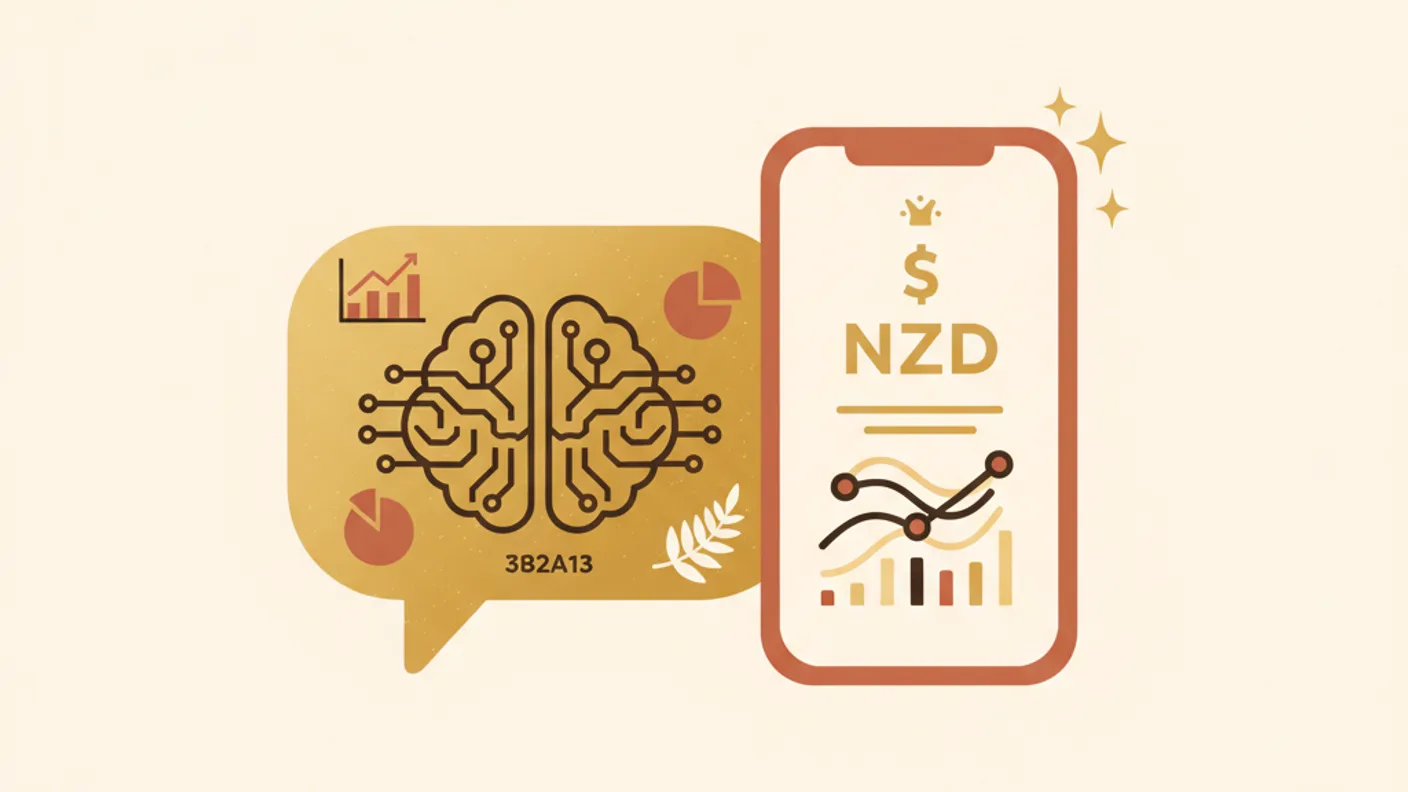
The short version
- When a transaction comes in from "WOOLWORTHS RICCARTON", AI knows that's groceries.
- A common concern: "If AI analyses my finances, where does my data go?"
- No. What gets sent is financial context — spending totals, categories, goal progress — without the identifying details attached to it.
Artificial intelligence isn't just for big tech companies anymore. It's quietly transforming how everyday New Zealanders manage their money, and it's one of the biggest reasons budgeting apps now beat spreadsheets.
The old way vs the new way
Old way: Open your banking app. Scroll through hundreds of transactions. Try to work out how much you spent on food this week. Give up and close the app.
New way: Ask your finance app "How much did I spend on food this week?" and get an instant answer with context: "You spent $127 on food this week, that's 15% more than last week, mostly from two Uber Eats orders."
That's the difference AI makes. Instead of you doing the analysis, the app does it for you. (Why a general chatbot cannot do this job is the other half of the story.)
What AI can do with your finances
Auto-categorisation
When a transaction comes in from "WOOLWORTHS RICCARTON", AI knows that's groceries. When it sees "NETFLIX.COM", it knows that's streaming. Steady uses pattern matching for common NZ merchants (Woolworths, Pak'nSave, Z Energy, Spark) and AI for everything else, so your spending breakdown is always accurate.
Plain-English answers
Instead of navigating through charts and graphs, you can just ask. Steady's AI assistant understands questions like:
- "Can I afford dinner out this weekend?"
- "How much am I spending on subscriptions?"
- "Am I on track for my holiday goal?"
- "Where can I cut back this month?"
Smart insights
AI can spot patterns you'd miss: "Your power bill went up 23% this month" or "You've been spending more on weekends lately." These proactive nudges help you stay on top of your money without constant manual checking. This is what makes checking your money daily so effective.
Privacy matters
A common concern: "If AI analyses my finances, where does my data go?"
In Steady, your financial data is processed by Anthropic's Claude API, but crucially, no direct personal information (name, email, account numbers) is sent. Only aggregated financial context like spending totals, categories, and goal progress. Anthropic doesn't train on API data.
Under New Zealand's Privacy Act 2020, your financial data is personal information. Any app using AI with your finances should be transparent about what data goes where, check their privacy policy. See how Steady handles your data.
Does the AI see my name and account number?
No. What gets sent is financial context — spending totals, categories, goal progress — without the identifying details attached to it.
Your name, your email and your account numbers stay on Steady's side. The model is answering a question about a set of numbers, not about a named person.
That distinction is the one worth asking any app about. Plenty send far more than they need to, and the privacy policy is where it has to be written down.
Can an AI give me financial advice?
Not in New Zealand, and not because the technology is short of an opinion.
Giving personalised financial advice here requires a Financial Advice Provider licence, and that is a deliberate consumer protection rather than red tape. An app without one can show you your own numbers, explain how something works, and answer questions about what you have already done.
What it cannot do is tell you which fund to buy or whether to break your fixed rate. For that, a licensed adviser is the answer, and the FMA register is where you find one.
How accurate is automatic categorisation?
Very good on the merchants New Zealanders actually use, and imperfect at the edges, which is why every category stays editable.
Common merchants are matched by name, so a supermarket is groceries and a fuel stop is transport every time. The AI handles the rest, and the hard cases are genuinely ambiguous — a hardware store might be a home repair or a hobby, and no system can know which.
Correcting one is worth the two seconds. The categories are what every other number on the screen is built from.
What can AI not do with my money?
Three things, and they are the three people most often assume it can.
It cannot move money. The connection is read-only, so nothing an AI decides can result in a payment. It cannot see what has not arrived yet, because bank data refreshes at most twice a day. And it cannot predict markets, however confidently any chatbot phrases the answer.
What it can do is remove the work between your transactions and a clear answer. That is a smaller claim and a more useful one.
The bottom line
AI doesn't replace financial literacy. It removes the friction of tracking and analysis, so you can focus on making good decisions instead of crunching numbers. The best personal finance app is one you actually use, and AI makes that a lot more likely. Try Steady's AI features.

Written by Sam Wilson
Founder, Steady
Sam is a New Zealand founder building Steady, a personal finance app designed for Kiwis, integrated with every major NZ bank via Akahu. He writes about money, bank integrations, and what actually works for everyday New Zealanders.More about Sam
Steady connects your bank and tracks it all automatically, no spreadsheets. Join the waitlist for early access.
Suggested reads
More from the Steady blog
How to Track Spending Automatically in NZ (2026 Guide)
Still entering transactions by hand? How to connect your NZ bank, what two years of history gets you, and how often the data actually refreshes.
7 Best Budgeting Apps for NZ in 2026 (Tested)
We tested every budgeting app available in NZ, here are the 7 that actually connect to your bank via Akahu, with honest pros, cons, and real pricing. Updated September 2026.

What's Your Money Personality? 5 Types of NZ Spenders
Are you a Spender, Saver, Avoider, or Monk? Your spending personality explains why budgets keep failing, and what to do instead.
Ready to sort your money?
Steady connects to your NZ bank accounts and helps you track spending, set goals, and get AI-powered insights.
Try Steady free