First Home Grant vs First Home Loan in NZ (2026)
Two different government schemes for first-home buyers, often confused. The First Home Grant closed in May 2024; the First Home Loan still lets you buy with a 5% deposit. A side-by-side for 2026.

The short version
- Status September 2026: Closed to new applications since 22 May 2024, permanently.
- The First Home Loan scheme is a partnership between Kāinga Ora and approved lenders (Westpac, Co-operative Bank, SBS, NZHL, Unity, plus 5 others as of June 2026).
Two government schemes for NZ first-home buyers are routinely confused. They're different, the rules changed in 2024, and one of them no longer exists.
First Home Grant (closed)
Status September 2026: Closed to new applications since 22 May 2024, permanently. Budget 2024 redirected the funding to social housing; it is not returning. If you already had an active KiwiSaver-First-Home-Grant application at that date, you can still claim. New first-home buyers cannot.
The grant was $3,000-10,000 depending on how long you'd been in KiwiSaver. Most never got the full amount because of regional house price caps that lagged the market.
If you're reading this in 2026, you almost certainly cannot get this grant. Move on.
First Home Loan (still active)
The First Home Loan scheme is a partnership between Kāinga Ora and approved lenders (Westpac, Co-operative Bank, SBS, NZHL, Unity, plus 5 others as of June 2026).
It lets you buy with as little as 5% deposit, below the standard 20% the RBNZ requires for most owner-occupied lending.
Eligibility
- First-home buyer (or in similar circumstances).
- Household income cap: $95,000 if buying alone, $150,000 for couples / families.
- House price cap: regional, Auckland $875k, Wellington / Christchurch $750k, most of NZ $600k (figures as of 2026, recheck on the Kāinga Ora site).
- Must occupy the property as your main home.
How it works
You apply through one of the approved lenders, not the government. Kāinga Ora effectively underwrites the lender against your low deposit, which lets them ignore the RBNZ's 80% LVR limit for you.
You pay a 0.5%-1.0% Lenders Mortgage Insurance premium as a one-off cost (depending on your deposit %).
Worked example: First Home Loan at 5%
- House price: $600k.
- 5% deposit: $30k.
- Mortgage: $570k.
- LMI premium (~1%): $5,700 added to the loan.
Vs the standard route:
- 20% deposit: $120k.
- Mortgage: $480k.
The First Home Loan lets you buy 3-5 years earlier but with a bigger mortgage, more interest paid over time, and a one-off insurance cost.
When the First Home Loan makes sense
- Rent is eating you alive, paying off your own mortgage is meaningfully cheaper than current rent.
- Income is stable and likely to grow (servicing capacity will improve).
- House price growth is expected in your area (you build equity faster than you pay LMI).
When to wait
- Rates are moving against you, the OCR bottomed and was raised in July and again on 2 September 2026, so waiting is no longer a bet on a cheaper rate.
- You can save $20k+/year, closing the gap to a 20% deposit in 2-3 years avoids LMI entirely.
- Your income or job is uncertain.
KiwiSaver first-home withdrawal
Separate from both schemes. If you've been in KiwiSaver for 3+ years, you can withdraw your balance (minus a $1,000 minimum) and use it toward your deposit. This works alongside the First Home Loan.
Can I still get the First Home Grant?
No. It closed to new applications on 22 May 2024 and it is not coming back.
Budget 2024 redirected the funding to social housing. The only people still claiming it are those whose application was already active on that date.
The reason it keeps coming up is that a great deal of advice online was written before the closure and has never been updated. If a page tells you to add $10,000 of grant money to your deposit, it is out of date, and the deposit plan built on it is short by that amount.
What is lenders mortgage insurance and do I have to pay it?
It is a one-off premium that insures the lender, not you, against the extra risk of a small deposit.
On a First Home Loan it is charged as a percentage of the loan, and it is usually added to the mortgage rather than paid up front. That means you also pay interest on it for the life of the loan.
It is unavoidable on the low-deposit route and entirely avoidable on the 20% route. That is the real cost of buying earlier, and it belongs in the comparison alongside the rent you would otherwise pay.
Can I use my KiwiSaver and the First Home Loan together?
Yes, and most people who use one use both.
The KiwiSaver first-home withdrawal supplies the deposit; the First Home Loan is what lets a smaller deposit be enough. They are separate schemes with separate rules and they do not conflict.
Apply for the KiwiSaver withdrawal early. Providers need notice, and the money goes to your solicitor rather than to you, so it has to be lined up well before settlement.
What if I earn slightly over the income cap?
Then the First Home Loan is out, and the standard route is what remains.
The caps are hard lines rather than sliding scales, and they are measured on household income before tax. A couple a few thousand over is treated the same as a couple far over.
It is worth checking the current figures directly with Kāinga Ora rather than trusting a number in an article, including this one. They move, and a rule that decides whether you can buy is worth reading at the source.
Where Steady fits
Use Steady to set up a "First Home" goal with a target amount and date. The forecast tells you the realistic month you'll hit the threshold, and Auto-track your KiwiSaver value so you know your full deposit picture.
Disclaimer: General education. Talk to a mortgage adviser or Kāinga Ora directly for your specific eligibility.
Steady tip: The First Home Loan adviser at one of the 10 approved lenders is free to talk to and can pre-assess you in 30 minutes, worth doing before you start house-hunting so you know your realistic ceiling.

Written by Sam Wilson
Founder, Steady
Sam is a New Zealand founder building Steady, a personal finance app designed for Kiwis, integrated with every major NZ bank via Akahu. He writes about money, bank integrations, and what actually works for everyday New Zealanders.More about Sam
Steady connects your bank and tracks it all automatically, no spreadsheets. Join the waitlist for early access.
Suggested reads
More from the Steady blog

How to Save for Your First Home in NZ (2026 Guide)
NZ house deposit in 2026: you need $120k (or less with these tricks). KiwiSaver withdrawal, what replaced the First Home Grant, and the exact savings plan.
How Much House Can I Afford in NZ? (2026 Calculator + Rules)
Banks use 6x income as a rough ceiling, but the test rate they apply is closer to 7.5%. Here's the realistic affordability picture for NZ buyers in 2026, with worked examples for $80k, $120k, and $200k household incomes.
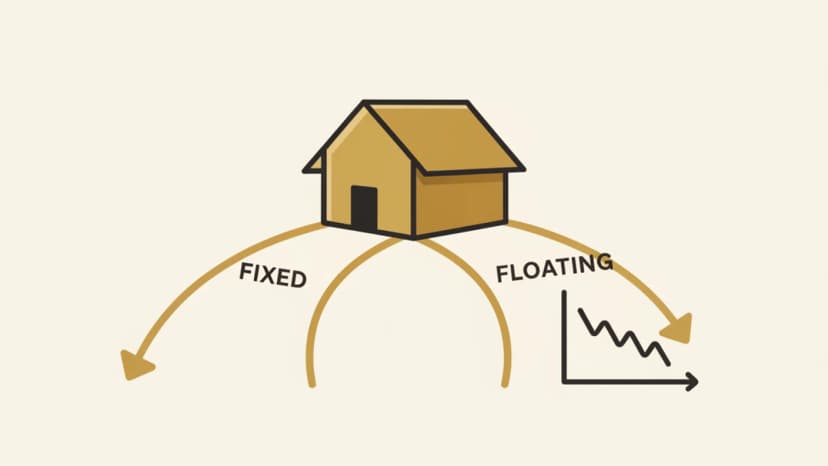
Mortgage Fixed vs Floating in NZ (2026): The Real Trade-off
Fixed locks your rate, floating moves with the OCR. In a falling-rate environment like 2026, which makes more sense? A practical guide to splitting, breaking, and the small print Kiwis miss.
Ready to sort your money?
Steady connects to your NZ bank accounts and helps you track spending, set goals, and get AI-powered insights.
Try Steady free