OCR Cuts in 2026: What They Mean for Your Mortgage and Savings
The OCR fell through early 2026, bottomed, and has since been RAISED twice to 2.75%. Here is what the turn means for your mortgage repayments and your savings interest.
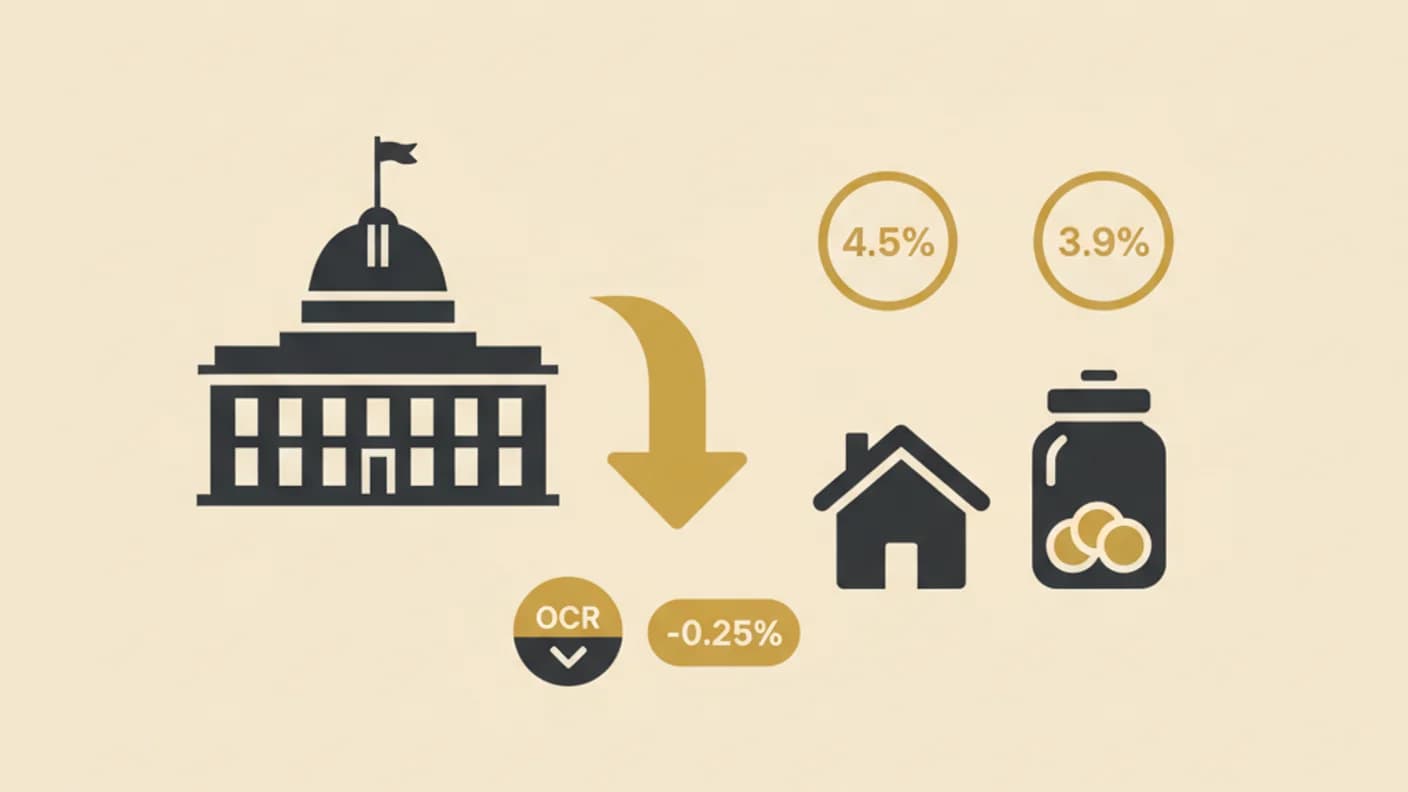
The short version
- That is 3.25 percentage points of cuts, a floor that held for three meetings, and then two hikes in a row.
- Most NZ mortgages are on fixed terms (1-5 years).
- The flip side. Lower OCR means banks pay less on deposits.
Correction, 15 September 2026. This post was written during the cutting cycle and described more cuts as the likely path. That cycle is over. The Reserve Bank raised the OCR to 2.50% in July 2026 and again to 2.75% on 2 September 2026, the second consecutive hike, with inflation at 4.1% in the June quarter. The mechanics below, how the OCR moves your mortgage and your savings, still hold exactly. The direction does not. Where you see "further cuts", read "further rises". Source: RBNZ.
The Reserve Bank of New Zealand cut the Official Cash Rate) (OCR) to 3.25% at the April 2026 review, the fifth cut in a row from the 5.50% peak we sat on through most of 2024. Markets are pricing in another cut by August. If you've got a mortgage, savings, or both, this is the rate environment you'll be living in for at least the rest of the year.
Here's what's actually happening, what it means for your money, and the moves worth making now.
Quick recap: The OCR is the rate the Reserve Bank charges retail banks. When it drops, banks pay less to borrow, so they charge you less on mortgages, and pay you less on savings. The spread between those two is roughly how banks make money.
Where the OCR sits today
| Date | OCR | Move |
|---|---|---|
| Aug 2023 | 5.50% | The peak |
| 2024-2025 | 5.50% → 2.25% | Cut, meeting after meeting |
| Feb, Apr, May 2026 | 2.25% | Held three times — the floor |
| 8 Jul 2026 | 2.50% | +25bp, the turn |
| 2 Sep 2026 | 2.75% | +25bp |
That is 3.25 percentage points of cuts, a floor that held for three meetings, and then two hikes in a row.
The turn is the part worth sitting with, because it is recent. When this post was first written the Bank's own forecasts had the OCR bottoming around 2.75%-3.00%, with annual inflation at 2.4% and comfortably in range. That was the March 2026 quarter, and it did not last: inflation hit 4.1% in the June quarter (Stats NZ), above the 1-3% target band, with petrol alone driving almost a quarter of the rise.
So 2.75% today is not the floor of a cutting cycle. It is two steps up from one.
What it means for your mortgage
Most NZ mortgages are on fixed terms (1-5 years). The OCR doesn't change your repayment overnight, it changes the rate you'll be offered when you next refix.
If you're refixing in the next 6 months
You'll see materially lower rates than 12 months ago. Indicative carded rates as of May 2026:
| Term | 2025 (peak) | Now | Difference |
|---|---|---|---|
| 1-year | 6.85% | 5.45% | -1.40% |
| 2-year | 6.65% | 5.55% | -1.10% |
| 3-year | 6.45% | 5.65% | -0.80% |
On a $600,000 mortgage dropping from 6.65% to 5.55%, monthly repayments fall from about $3,860 to $3,420, roughly $440 a month, $5,300 a year back in your pocket.
Steady tip: Don't just take the first rate the bank offers. The carded rate is the starting point, banks routinely shave 0.20-0.40% off for existing customers who ask, and even more for new business they're trying to win. See our breakdown of how to negotiate your mortgage rate.
If you're on a floating rate
Floating rates move almost in lockstep with the OCR. Floating sat around 6.20-6.65% when this was written; as at mid-September 2026 the big five are carding 6.14% - 6.34% (interest.co.nz), and floating rises with the OCR, so the two hikes are feeding through now. Cheaper than peak, but still meaningfully higher than fixed, most borrowers will save by locking in.
Should you fix short or long?
This paragraph described the old cycle and is left here only so the reasoning is visible. At the time, consensus was one more 25bp cut by August, making a 1-year fix the way to capture the last of the drop. What actually happened was two hikes, July and September.
The lesson is the durable part: match your fix to what you think the OCR does next, and accept that the consensus is regularly wrong. If you are more cautious, 2 years at ~5.55% is a defensible middle.
Avoid the 5-year rate unless you're truly worried about rates going back up, at the current curve, you're paying for protection you probably don't need.
What it means for your savings
The flip side. Lower OCR means banks pay less on deposits.
Savings accounts
Top bonus-saver rates have already dropped from peak:
| Account | 2025 (peak) | Now |
|---|---|---|
| Heartland Direct Call | 5.00% | 4.10% |
| Rabobank PremiumSaver | 4.85% | 4.00% |
| Kiwibank Notice Saver (32-day) | 4.75% | 3.95% |
| Big-bank standard savers | 1.50-2.00% | 0.50-1.50% |
If your savings are sitting in a standard transaction or "savings" account at one of the big four, you're earning close to nothing in real terms after inflation. Moving to a bonus saver account is the single highest-leverage money move most Kiwis can make right now, typically 3-4% extra interest on whatever you've got parked.
On a $20,000 emergency fund, the difference between 0.50% and 4.00% is $700 a year. Same money, different account.
Term deposits
Term deposit rates followed the OCR down through the cutting cycle: 6-12 month rates were around 4.20-4.60% as at May 2026, versus 5.80-6.20% at the peak. With the OCR now rising again, expect these to firm; we have not refreshed the figure here rather than print an estimate, so check current rates before you lock one in.
If you have money you genuinely won't need for 12+ months, locking a TD now still beats the floating-rate alternatives. But the gap has narrowed, for most people, an on-call bonus saver at 4.00% is worth more than a TD at 4.40% once you factor in the flexibility.
KiwiSaver
OCR cuts don't directly change KiwiSaver returns, KiwiSaver funds invest in shares, bonds, and property, not at the OCR rate. But:
- Conservative funds (heavily bonds) tend to do better when rates fall, because existing higher-yielding bonds become more valuable. Most conservative funds are up 4-7% over the past 12 months.
- Growth funds are driven mostly by share markets, which have been volatile but net-positive in 2026 (NZX50 up roughly 8% YTD).
Lower rates make KiwiSaver and other long-term investing relatively more attractive vs cash savings. If you've been parking money in TDs because rates were high, the gap is closing fast, see KiwiSaver vs savings account for when each makes sense.
What it means for the housing market
Lower OCR → lower mortgage rates → easier to service loans → more buyers can qualify. The standard textbook says house prices rise.
In practice, the 2026 picture is more nuanced:
- Prices are up modestly. REINZ's House Price Index is up roughly 4-5% nationally year-on-year, well below historical post-cut booms because supply is finally meaningful (record consents from 2022-2024 are now coming through as completed homes).
- First-home buyers have re-entered. Activity from buyers under 35 is up sharply on 2024 levels as serviceability improves.
- Investor demand is muted. Bright-line and DTI rules are still biting; investors are no longer dominating auctions the way they did pre-2022.
If you're saving for a first home, the window between "rates are low enough to afford" and "prices have run away again" is the time to be ready. See save for your first home in NZ for the practical checklist.
What to do this week
Three concrete moves, ordered by leverage:
- Move idle cash to a bonus saver. If you've got more than $5,000 sitting in a standard transaction account, you're losing real money. Heartland, Rabobank, and SBS all consistently sit near the top of the rate table. Set it up in 15 minutes.
- Check your mortgage refix date. If you're refixing in the next 6 months, ring your bank now and ask what rate they'd offer if you refixed today. Compare against rivals. Most banks will match a written offer from a competitor.
- Update your budget. A lower mortgage rate is a chance to redirect, not absorb. If your repayment drops $400/month, route at least half of it straight into your emergency fund or KiwiSaver before lifestyle creep gets it.
What to ignore
- "Rates will be back at zero by Christmas" predictions. They won't. The Reserve Bank's neutral OCR estimate is 2.75-3.50%. Anything below that needs an actual recession to justify.
- The "fix for 5 years now while you can" pitch. You're paying for certainty most borrowers don't need. The current 1-2 year rates are lower than the 5-year for a reason.
- Anyone telling you to take on more debt because money is "cheap" again. Real mortgage rates (after inflation) are still positive. They're cheaper than 2024, they're not free.
How Steady can help
Whether the OCR rises or falls, what makes the biggest difference is knowing where your money is going. Steady connects to your bank via Akahu and shows you:
- How much your mortgage repayment dropped after refixing (and where the saving actually went).
- Whether your savings are earning what they should be.
- A daily safe-to-spend number that adjusts as your fixed costs change.
Try it free, no credit card, takes 90 seconds to connect your accounts.
Frequently asked questions
When's the next OCR review?
The Reserve Bank holds seven Monetary Policy Statement reviews per year. The next is 9 July 2026. Markets are pricing roughly a 70% chance of another 25bp cut.
Should I break my fixed mortgage to get a lower rate?
Usually not. Banks charge a "break fee" that's calibrated to wipe out most of the saving. Run the numbers, your bank can give you the exact break-fee figure on request, but in 9 cases out of 10, you're better off waiting for your refix date.
Will my KiwiSaver returns drop if rates keep falling?
Probably the opposite for conservative and balanced funds, falling rates lift bond values. Growth funds are driven by shares, so the OCR matters less. The bigger lever is fees, not the OCR, see which KiwiSaver fund type to choose.
Are term deposits still worth it?
Only if you genuinely won't need the cash for 12+ months and the TD rate is meaningfully above the best bonus saver. At current rates, a 12-month TD at 4.40% beats a 4.00% bonus saver by $80 per $20,000, small enough that the bonus saver's flexibility usually wins.
Should I refinance to a different bank?
Worth a 15-minute call. Banks offer cash incentives (typically 0.6-0.9% of the loan, capped around $5,000) for new customers, and existing customers who threaten to switch usually get rate matches. Even if you don't switch, the call costs nothing and often pays for itself.
---
The 2026 rate environment is a chance to lock in real wins, lower mortgage costs, better savings yields if you move accounts, and breathing room to redirect to long-term goals. The default behaviour (do nothing, refix on whatever your bank offers, leave savings in a 0.50% account) is exactly the move that lets the cuts pass through to the bank instead of you.

Written by Sam Wilson
Founder, Steady
Sam is a New Zealand founder building Steady, a personal finance app designed for Kiwis, integrated with every major NZ bank via Akahu. He writes about money, bank integrations, and what actually works for everyday New Zealanders.More about Sam
Steady connects your bank and tracks it all automatically, no spreadsheets. Join the waitlist for early access.
Suggested reads
More from the Steady blog

NZ Mortgage Rates 2026: Fixed vs Floating and How to Save Thousands
NZ mortgage rates updated May 2026, fixed vs floating, the latest 1- and 2-year rates from the big four, and the fortnightly trick that still saves $30k+ over the loan life.
Best Savings Accounts in NZ (2026 Comparison)
Your savings account is probably paying 0.05%. These NZ accounts pay 10-50x more, updated rates from every major bank for 2026.

ANZ vs ASB vs Kiwibank: Which Is the Best NZ Bank in 2026?
ANZ Go, ASB Streamline and Kiwibank Free Up all cost $0 a month in 2026. A fee-by-fee comparison of the big three, checked against each bank's published schedule.
Ready to sort your money?
Steady connects to your NZ bank accounts and helps you track spending, set goals, and get AI-powered insights.
Try Steady free