Rent vs Buy in NZ 2026: The Real Math (With Calculator Logic)
House prices flat-ish, rents still climbing, mortgage rates dropping. The 'rent is dead money' line is half-true. A worked comparison for $700k vs renting at $600/week in 2026.
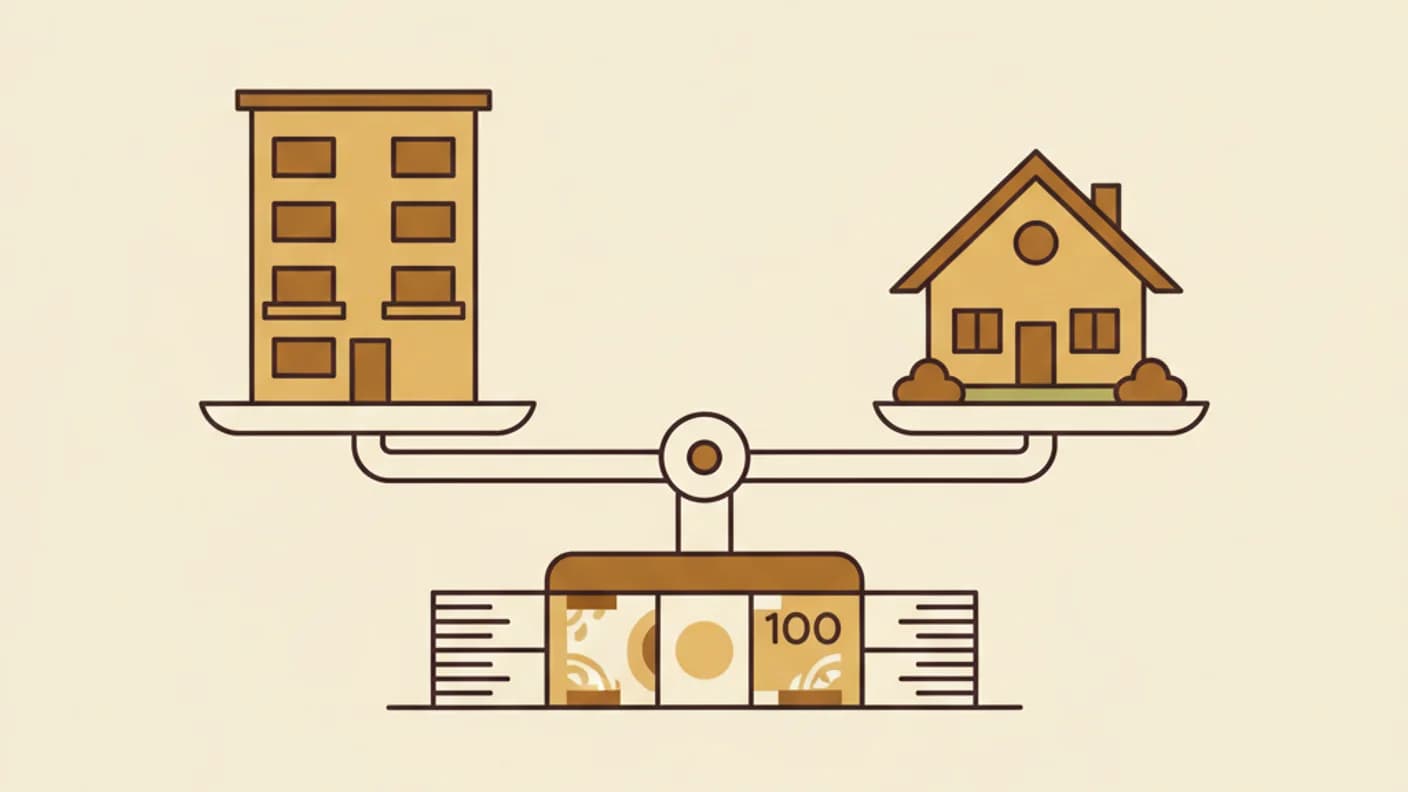
The short version
- At first glance, buying costs ~$520/month more.
- Each mortgage payment splits into interest and principal.
- NZ house prices grew ~3.5% p.a. on average from 1990-2023 (well above inflation). 2024-2026 have been flat-to-down as the post-COVID correction worked through.
"Rent is dead money" is the line you've been told since you got your first job. It's half true. In 2026, with house prices flat-to-slightly-down, mortgage rates around 6%, and rents up 6% nationally, the rent vs buy calculation is much tighter than most Kiwis assume.
Here's the worked math.
The case study
- House price: $700,000 (median 3-bed in regional NZ; well below Auckland).
- Mortgage: 80% LVR = $560,000 at 5.95% fixed for 1 year. (Rate used for this worked example, from early 2026. Carded 1-year rates in mid-September 2026 are around 4.6%, so a buyer today pays less than the figures below; the comparison logic is unchanged.)
- Monthly mortgage repayment: ~$3,340 (30-year term).
- Equivalent rent: $650/week = ~$2,820/month.
At first glance, buying costs ~$520/month more. But that's not the full picture.
What buying really costs
Mortgage payment isn't the only cost of owning:
- Rates: ~$3,500/year = $292/month.
- House insurance: ~$2,000/year = $167/month.
- Maintenance: ~1% of house value/year = $7,000 = $583/month.
- Body corp (if apartment): variable, can add $200-500/month.
For our $700k house: mortgage $3,340 + rates $292 + insurance $167 + maintenance $583 = $4,382/month all-in. That rates figure is an average — yours comes from your capital value and your council's rate in the dollar, and the sum is simpler than the notice makes it look.
Vs renting at $650/week ($2,820/month) + contents insurance $40/month = $2,860/month.
Buying is $1,522/month more expensive in cash terms.
But, the equity
Each mortgage payment splits into interest and principal. In year 1 of a 5.95% 30-year loan, only ~$520/month goes to principal, the rest is interest (gone forever, like rent).
By year 5: ~$700/month principal. Year 10: ~$1,100/month. The principal portion is "forced savings", you're not really spending it, you're moving it from your bank account into your equity.
What about house price growth?
NZ house prices grew ~3.5% p.a. on average from 1990-2023 (well above inflation). 2024-2026 have been flat-to-down as the post-COVID correction worked through.
At 3.5% p.a. on $700k = $24,500/year of unrealised gain. Tax-free if it's your main home.
The market could just as easily be down 5% next year. House price growth is highly cyclical and regional. Don't buy on the assumption prices always rise, but do recognise that historically they have, by enough to make ownership a wealth-builder.
What about rent increases?
NZ rents grew 6.0% p.a. over 2025. If your $650/week rent rises at 5% annually:
- Year 1: $2,820/month
- Year 5: $3,427/month
- Year 10: $4,372/month
By year 10, you're renting at roughly the mortgage payment you locked in today. By year 15, you're paying significantly more than the (eventually fully-paid) mortgage owner.
The breakeven point
For our case study (5% rent growth, 3% house price growth, $700k house at 5.95% mortgage):
- Year 1-7: Renting is cheaper.
- Year 8-9: They break even.
- Year 10+: Buying wins, and the gap widens fast.
If you're going to stay in one place less than 7 years, renting is mathematically better in 2026. More than 10 years, buying probably wins. Between 7 and 10 it's a coin flip dependent on the actual rent and house-price trajectories.
Other factors
Renting:
- Flexible. Move for a new job or relationship without selling.
- No exposure to interest-rate shocks.
- No maintenance hassles.
- Landlord risk: rent can be hiked, lease ended.
Buying:
- Forced savings via principal repayment.
- Tax-free capital gain (main home).
- Stability, can't be evicted (assuming you pay).
- Freedom to renovate.
The unspoken third option: rent + invest the difference
If you're going to rent for the next 5 years anyway, take the $1,500/month cash flow gap between renting and buying and invest it monthly in a low-cost index fund (Sharesies, InvestNow, Kernel).
At 8% returns over 5 years: ~$110,000 portfolio. Combined with a 5-year deposit save, you can be in a better financial position than if you'd bought in year 1.
Where Steady fits
Use Steady's "Goal" feature to model both scenarios:
- Buy now: Mortgage + insurance + rates as recurring bills.
- Rent + invest: Rent as a fortnightly cost, savings goal toward a future deposit + investment goal.
Watch the net worth trajectory of each over 6 months of actual cash flow. Real numbers, not assumptions.
Disclaimer: General education only. Talk to a mortgage adviser for your specific situation.
Steady tip: If you decide to keep renting, set up an automatic transfer of the "saved" amount each pay into a separate investment account. Without forcing it via automation, the gap money gets absorbed by lifestyle.

Written by Sam Wilson
Founder, Steady
Sam is a New Zealand founder building Steady, a personal finance app designed for Kiwis, integrated with every major NZ bank via Akahu. He writes about money, bank integrations, and what actually works for everyday New Zealanders.More about Sam
Steady connects your bank and tracks it all automatically, no spreadsheets. Join the waitlist for early access.
Suggested reads
More from the Steady blog
How Much House Can I Afford in NZ? (2026 Calculator + Rules)
Banks use 6x income as a rough ceiling, but the test rate they apply is closer to 7.5%. Here's the realistic affordability picture for NZ buyers in 2026, with worked examples for $80k, $120k, and $200k household incomes.
How Much Should You Spend on Rent in NZ?
Is your rent too high? The 30% rule says most Kiwis are overpaying. Here's what you should actually spend, with NZ city benchmarks.
How Are Council Rates Calculated in NZ? (2026 Guide)
Rates notices explain almost nothing. Here is the actual arithmetic behind the number, with a worked Christchurch example, plus why your bill can fall after a revaluation and how to work out what each instalment will be.
Ready to sort your money?
Steady connects to your NZ bank accounts and helps you track spending, set goals, and get AI-powered insights.
Try Steady free