New Build vs Existing Home in NZ (2026): The Full Cost Comparison
New builds in NZ need a smaller deposit and less maintenance. Existing homes usually cost less per square metre. A side-by-side of deposits, hidden costs and 30-year totals for first-home buyers.
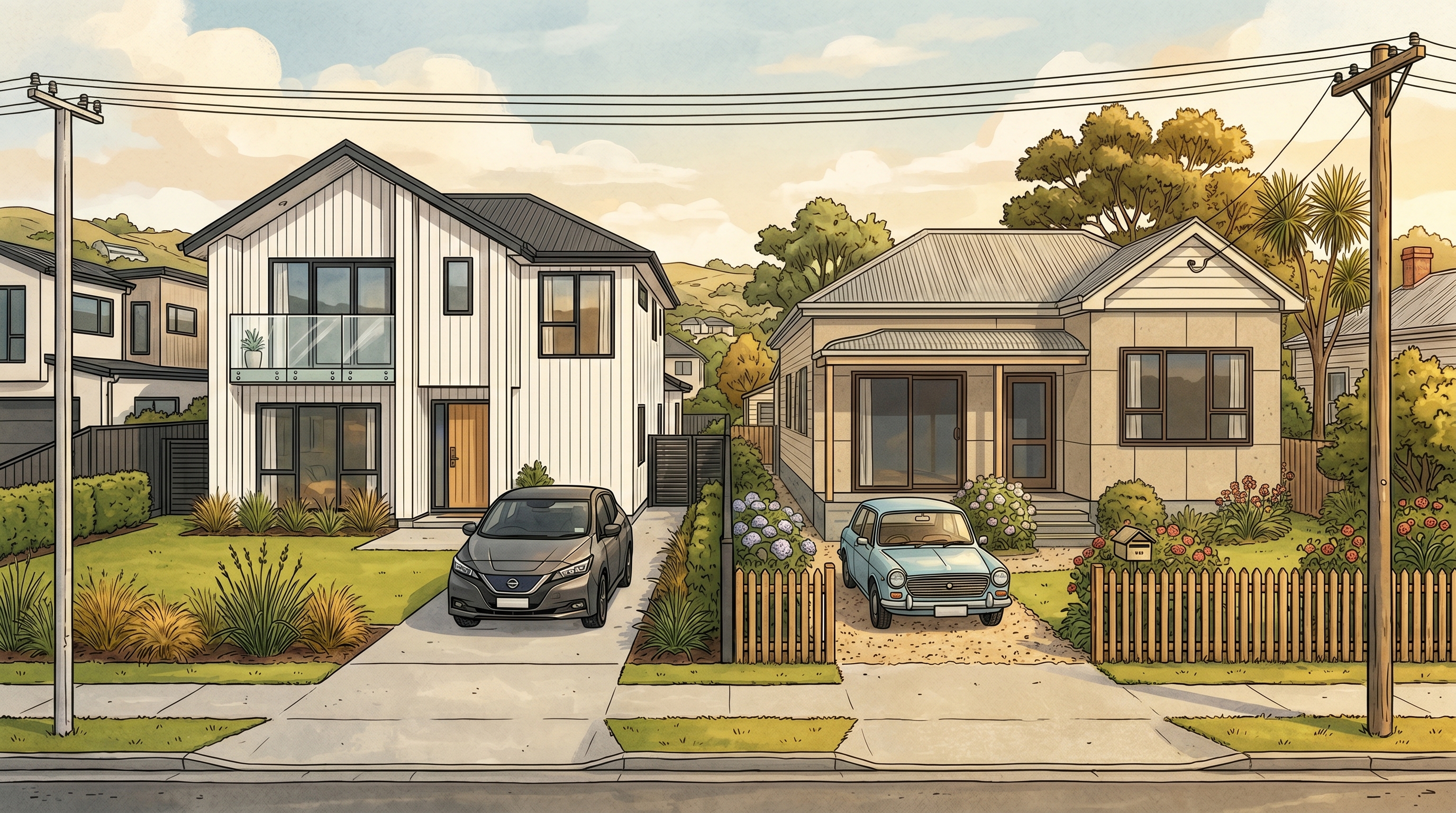
Quick answer: In 2026 a new build usually needs a smaller deposit (often 10%, because new builds are exempt from the Reserve Bank's loan-to-value limits) and costs less to maintain in the first decade.
An existing home usually costs less per square metre, often 15–25% less in our estimates, and can work out cheaper over 30 years, but most banks want a 20% deposit. Which is cheaper for you depends on your deposit, how long you will stay, and whether you are prepared to renovate.
First-home buyers get pointed toward new builds: a 10% deposit, KiwiSaver-friendly settlement, and "no maintenance for ten years". Some of that holds up and some does not. This guide sets out the costs on both sides, including the ones that are not in the brochure. If you are still saving, the first-home plan shows how Steady tracks a deposit.
Work out your own number: the house deposit calculator shows how long it takes to reach 10% or 20%.
What the deposit rules say
The Reserve Bank's loan-to-value (LVR) rules are the main reason banks promote new builds:
- Existing homes: owner-occupiers generally need a 20% deposit. Some lenders accept 15%, but it is limited.
- New builds: exempt from LVR limits. Banks often lend at 80–90% LVR.
On an $800,000 home the difference is large:
- 20% deposit on an existing home: $160,000
- 10% deposit on a new build: $80,000
If the deposit is what is holding you back, a new build opens the door. The catch is that the $80,000 you did not save is $80,000 more borrowed, with interest for 25–30 years. At 5.5% over 30 years that is roughly $83,000 in extra interest. Our guide to how much house you can afford shows how the bank sizes the loan.
Price per square metre
This is where existing homes usually win. Our rough estimates for early 2026:
| Property type | Auckland | Wellington | Christchurch | Hamilton |
|---|---|---|---|---|
| New build (3-bed standalone) | ~$8,500/m² | ~$7,200/m² | ~$5,600/m² | ~$6,400/m² |
| Existing (3-bed, 20–30 yrs old) | ~$7,000/m² | ~$6,100/m² | ~$4,800/m² | ~$5,400/m² |
These are estimates, not published figures, and prices vary a lot by suburb. The gap runs about 15–25%. On a 140m² home that is roughly $140,000–$210,000 more for the new build, which is a lot to make back through lower power and maintenance costs.
Costs of a new build that are easy to miss
Body corporate and shared services
Many recent new builds sit on smaller sections with shared driveways or a full body corporate. Expect fees of roughly $1,500–$4,000 a year that a standalone older house does not have.
Smaller sections
New-build sections, especially in Auckland, are much smaller than they used to be. If outdoor space matters to you, count that as a cost.
The builder's guarantee
Most new builds come with a 10-year guarantee, which is worth having. You pay for it in the build price.
Solar, heat pumps and EV charging
Brochure photos often show them. The standard package often has none. Adding them later can cost $15,000–$30,000.
Landscaping
New builds are often handed over with grass seed and a fence. Driveway, planting, back fence and a deck can add $10,000–$25,000 in the first year.
Add those up and a $750,000 new build can cost $810,000–$830,000 by the time you live in it.
Costs of an existing home that are easy to miss
The building inspection
Budget $700–$1,200 for a builder's report. It will almost always find deferred maintenance. You can negotiate the price down, but you still pay to fix what you take on.
Insulation and heating
A 1970s house may have little ceiling insulation, none underfloor and single glazing. Bringing it up to a similar standard can cost $8,000–$20,000. If you qualify, the Warmer Kiwi Homes grant can cover part of the insulation and a heat pump.
Roof and cladding
The roof is usually the largest end-of-life cost. A full replacement can run $15,000–$30,000.
Power bills
Older homes cost more to heat. Over ten years the difference can be tens of thousands of dollars.
A maintenance reserve
A common rule of thumb is to set aside about 1% of the property's value a year. In practice the spending comes in waves: quiet for a few years, then a large bill.
A 30-year comparison
Two illustrative examples for the same buyer in the same Auckland suburb. Every figure here is an assumption, so treat the totals as a rough guide, not a forecast.
Option A: new 3-bed townhouse, $820,000
- Deposit (10%): $82,000
- Mortgage: $738,000 at 5.5% over 30 years
- Body corporate: $2,500 a year
- Maintenance: $1,500 a year for ten years, then $4,000 a year
- Power: $200 a month on average
- Estimated 30-year cost: about $1.78 million
Option B: 1980s 3-bed standalone, $720,000
- Deposit (20%): $144,000
- Mortgage: $576,000 at 5.5% over 30 years
- Insulation and heating in year one: $14,000
- New roof in year eight: $24,000
- Maintenance: $7,000 a year
- Power: $320 a month on average
- Estimated 30-year cost: about $1.71 million
On these assumptions the existing home costs about $70,000 less over 30 years, but needs about $62,000 more deposit on day one.
When each one makes sense
A new build suits you when:
- the deposit is your constraint, not your income
- you do not want to spend weekends on maintenance
- you plan to stay five to ten years and want predictable costs
- warmth matters a lot (a cold climate, asthma, young children)
- the price gap to similar existing homes is under 10%
An existing home suits you when:
- you already have a 20% deposit
- you plan to stay 15 years or more
- you want a bigger section or a location new builds cannot offer
- you are handy, or know tradespeople
- the new-build premium where you are buying is over 20%
What about KiwiSaver?
You can use KiwiSaver for either, once you have been a member for at least three years. While you save, our savings guides cover where to keep a deposit. The First Home Grant, which paid more for new builds, closed to new applications on 22 May 2024. Our guide to KiwiSaver first-home withdrawals covers how the withdrawal works.
What about interest rates?
Lower interest rates help both buyers, but the bigger loan gains more in dollars. A new-build buyer with a $740,000 mortgage saves more than an existing-home buyer with $576,000. For buyers short on cash, that tips things slightly toward a new build. Our NZ mortgage rates guide has the current bank rates.
How to decide
Do not decide from the brochure. Run the 30-year numbers with the costs on both sides, then weigh three things:
- The deposit gap. If you can reach 20% within about two years, existing homes become an option.
- How long you will stay. Under about seven years, a new build often wins on transaction costs alone. Over 15 years, an existing home usually wins.
- How you feel about renovating. This is the deciding factor for many buyers, and no spreadsheet captures it.
Steady connects to your NZ bank accounts and tracks your deposit goal alongside your day-to-day spending, with a safe-to-spend number for each pay cycle, so you can see when you pass 10% and 20%.

Written by Sam Wilson
Founder, Steady
Sam is a New Zealand founder building Steady, a personal finance app designed for Kiwis, integrated with every major NZ bank via Akahu. He writes about money, bank integrations, and what actually works for everyday New Zealanders.More about Sam
Steady tracks your deposit to the month you'll cross the line. Join the waitlist for early access.
Suggested reads
More from the Steady blog
How Much House Can I Afford in NZ? (2026 Calculator + Rules)
Banks use 6x income as a rough ceiling, but the test rate they apply is closer to 7.5%. Here's the realistic affordability picture for NZ buyers in 2026, with worked examples for $80k, $120k, and $200k household incomes.

NZ Mortgage Rates 2026: Fixed vs Floating, and Getting a Better Rate
Carded NZ mortgage rates at the big five banks in September 2026, how fixed and floating compare, why many people split their loan, and how to negotiate a better rate at refix time.
Using Your KiwiSaver for a First Home in 2026: The Full Guide
How the KiwiSaver first-home withdrawal works in 2026, eligibility, the $1,000 you must leave behind, the application timeline, and why the First Home Grant is no longer part of the picture on top.
Ready to sort your money?
Steady connects to your NZ bank accounts and helps you track spending, set goals, and get AI-powered insights.
Try Steady free