New Build vs Existing Home in NZ (2026): The Real Cost Breakdown
First-home buyers in NZ keep getting pitched new builds. Lower deposit, KiwiSaver-friendly, brighter brochures. But existing homes still win on price-per-square-metre and total cost. Here's the honest 2026 comparison.
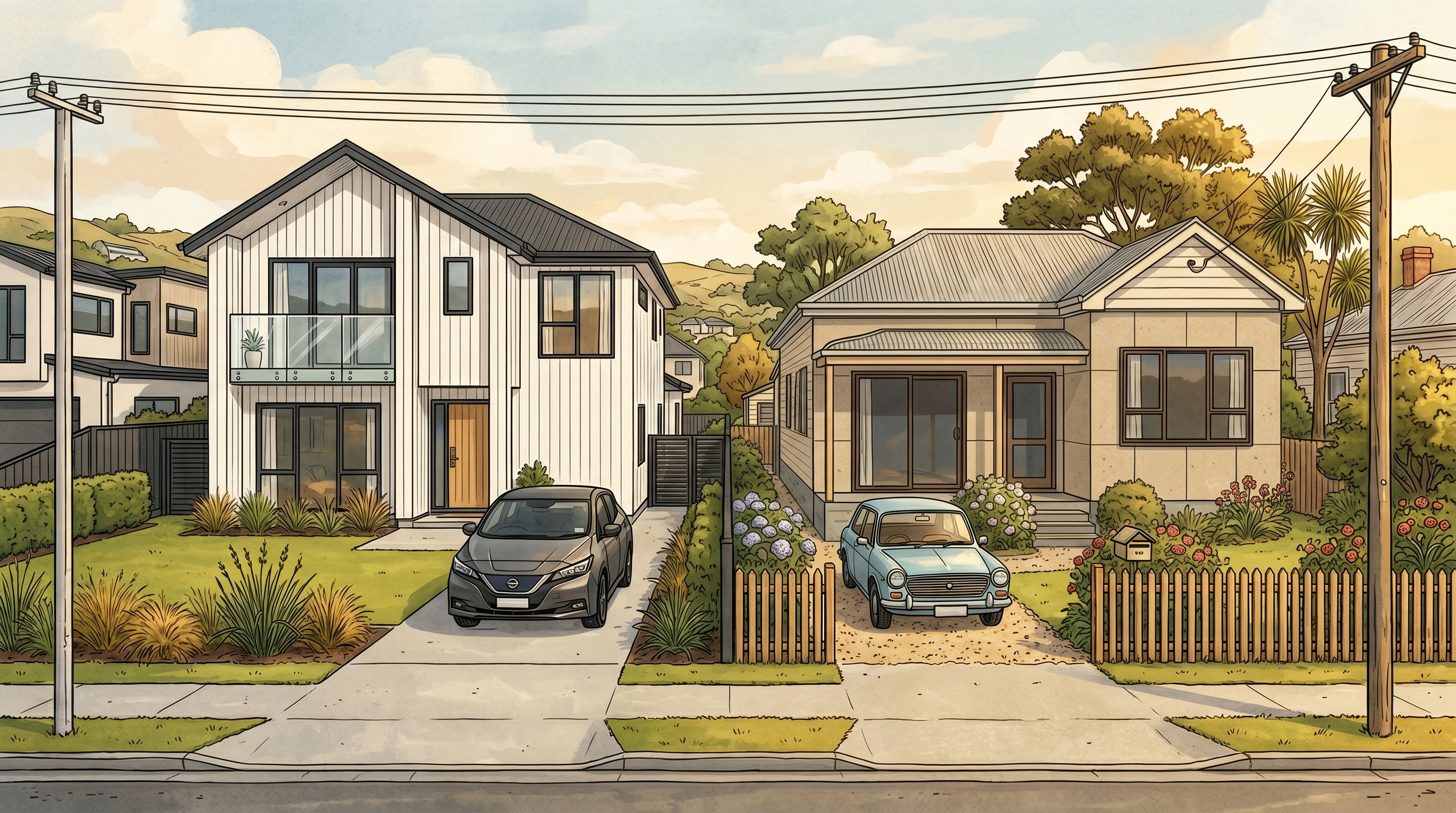
The short version
- For pure financial maths, existing homes still win on a $/m² basis in 2026, usually by 15-25%.
- The Reserve Bank's loan-to-value ratio rules are the single biggest reason banks push new builds.
- This is the number new-build marketing rarely shows side-by-side.
Buying your first home in NZ in 2026? You're being funnelled, hard, toward new builds. Banks advertise the 10% deposit. Developers push the KiwiSaver-friendly settlement. Real-estate agents pitch the "no maintenance for 10 years" line. And the headlines say new builds are the only path through tight LVR rules.
Some of that is true. A lot of it isn't. Here's the honest breakdown of what new builds vs existing homes actually cost in 2026, including the hidden numbers nobody puts on the brochure.
The short answer
For pure financial maths, existing homes still win on a $/m² basis in 2026, usually by 15-25%. New builds win on lower deposit requirements, lower maintenance for the first 5-10 years, and higher energy efficiency that compounds over decades.
Which one is actually cheaper for you depends on three things:
- How much deposit you have
- How long you plan to stay
- Whether you can stomach a renovation
What the LVR rules actually say in 2026
The Reserve Bank's loan-to-value ratio rules are the single biggest reason banks push new builds. Quick refresher:
- Existing homes: Owner-occupiers generally need a 20% deposit. Some lenders allow 15% but it's tight.
- New builds: Exempt from LVR rules. Banks routinely lend at 80-90% LVR, sometimes higher with KiwiBuild or Kāinga Ora.
That's the headline number, and yes, on a $800,000 property the difference is real:
- 20% deposit on existing: $160,000
- 10% deposit on new build: $80,000
So if your deposit is the constraint, new builds genuinely open the door. The catch: the $80k saved in deposit comes back as $80k extra borrowed, plus interest for 25-30 years. At 5.5% over 30 years that's roughly $83,000 in additional interest, almost the same amount again.
Price per square metre, where existing wins
This is the number new-build marketing rarely shows side-by-side. Across NZ in early 2026:
| Property type | Auckland | Wellington | Christchurch | Hamilton |
|---|---|---|---|---|
| New build (3-bed standalone) | ~$8,500/m² | ~$7,200/m² | ~$5,600/m² | ~$6,400/m² |
| Existing (3-bed, 20-30 yrs old) | ~$7,000/m² | ~$6,100/m² | ~$4,800/m² | ~$5,400/m² |
The premium runs 15-25% depending on city and property type. On a 140m² home that's roughly $140,000–$210,000 extra for the new build. Even after the better insulation and lower maintenance, that's a big premium to make back.
Costs nobody puts on the new-build brochure
The sticker price is the price. The actual cost is higher. In rough order of size:
1. Body corporate / shared services
Most new builds in NZ since 2022 sit on smaller sections with shared driveways, shared waste, or full body corporate setups. Expect $1,500-$4,000/year in fees that an old detached villa doesn't have.
2. Smaller sections
Average new-build section size in Auckland has dropped from 540m² in 2010 to under 280m² in 2026. Beautiful indoor-outdoor flow, no room for kids to kick a ball. If outdoor space matters to you, factor in the lifestyle cost.
3. Master Build / NZ Certified Builders premium
Most new builds come with a 10-year structural guarantee, great. But you pay for it upfront. Roughly $8,000-$15,000 baked into the build cost.
4. Solar, heat pump, and EV charging "options"
Brochure photos show solar panels and ducted heat pumps. Standard package usually has neither. Adding them later costs $15,000-$30,000.
5. Landscaping
New builds hand over with grass seed and a fence. Driveway sealing, planting, fencing the back boundary, decks, easily $10,000-$25,000 in year one.
Add it up and a $750k "new build" is often a $810-830k property by the time you actually live in it.
Costs nobody puts on the existing-home brochure either
Fair's fair. Existing homes have their own hidden numbers:
1. Building inspection issues
Budget $700-$1,200 for a full builder's report. If it surfaces deferred maintenance (it almost always does), you negotiate the price down, but you still pay to fix what you take on.
2. Insulation + heating retrofit
A 1970s home likely has minimal ceiling insulation, no underfloor, single-glazed windows. Bringing it up to a comparable thermal standard runs $8,000-$20,000 depending on size.
3. Roof + cladding
The roof is the single biggest end-of-life expense. A 30-year-old colorsteel roof has 5-15 years left. Full replacement: $15,000-$30,000.
4. Power bills
Existing homes are roughly 2-3× the running cost of a new build. On a $300/month winter average, that's $150-200/month extra. Over 10 years, $18,000-$24,000 in extra power.
5. Maintenance reserve
Older homes need a reserve. Rule of thumb: 1% of property value per year for first 10 years of ownership. On a $700k house that's $7k/year. Realistically you spend it in waves, quiet for 3 years, then $20k in one go.
A real 2026 head-to-head
Two examples, same buyer, same suburb, 30-year timeframe. Numbers are approximate but realistic for 2026 Auckland:
Option A: New 3-bed townhouse, $820k
- Deposit (10%): $82,000
- Mortgage: $738,000 @ 5.5% over 30 years
- Body corp: $2,500/yr
- Maintenance reserve: $1,500/yr (year 1-10), $4,000/yr after
- Power: $200/month average
- 30-year total cost of ownership: ~$1.78M
Option B: 1980s 3-bed standalone, $720k
- Deposit (20%): $144,000
- Mortgage: $576,000 @ 5.5% over 30 years
- Insulation/heating retrofit Year 1: $14,000
- Roof replacement Year 8: $24,000
- Maintenance reserve: $7,000/yr
- Power: $320/month average
- 30-year total cost of ownership: ~$1.71M
Existing wins by about $70k over 30 years, but you needed an extra $62k of deposit on day one to play.
So when does each one make sense?
Go new build when:
- Deposit is your constraint, not income
- You hate the idea of weekend DIY
- You're staying 5-10 years and want predictable costs
- You'd genuinely use the better insulation (cold climate, asthma, young kids)
- The price gap to comparable existing stock is under 10%
Go existing when:
- You've got the 20% deposit ready
- You're staying 15+ years (maintenance evens out)
- You want a bigger section / character / location new builds can't match
- You're handy or have trades in your network
- You're buying somewhere the new-build premium is over 20%
What about KiwiSaver?
Both options allow you to withdraw from KiwiSaver for your first home (after 3+ years membership). The First Home Grant used to pay more for new builds, but it closed to new applications on 22 May 2024 and is not coming back. See our full guide on KiwiSaver first-home withdrawals.
What about the OCR cuts?
2026's lower OCR means cheaper mortgages on both sides, but the proportional benefit goes to the bigger loan. A new-build buyer with a $740k mortgage benefits more in absolute dollars than an existing-home buyer with a $576k mortgage. Combined with lower deposit requirements, that tips the scales slightly back toward new builds for cash-constrained buyers. Full breakdown: OCR cuts and your mortgage in 2026.
The honest answer
Don't pick based on the brochure. Run the 30-year numbers, including hidden costs on both sides, and pick based on:
- Deposit gap. Can you actually get to 20% within 2 years? If yes, existing options open up.
- Stay duration. Under 7 years, new build wins on transaction friction alone. Over 15, existing typically wins.
- Tolerance for renovation. This is the real swing factor and no spreadsheet captures it.
Steady tip: Connect your accounts to Steady to see your real first-home deposit progress against either target. The app shows you a safe-to-spend number and tracks your deposit goal alongside your day-to-day spending, so you'll know exactly when you cross the 10% (new build) and 20% (existing) thresholds.
Either way, the worst move is the default one: buying the first property you tour without running the side-by-side. The premium for a new build can be worth it. It just isn't worth it by default.

Written by Sam Wilson
Founder, Steady
Sam is a New Zealand founder building Steady, a personal finance app designed for Kiwis, integrated with every major NZ bank via Akahu. He writes about money, bank integrations, and what actually works for everyday New Zealanders.More about Sam
Steady connects your bank and tracks it all automatically, no spreadsheets. Join the waitlist for early access.
Suggested reads
More from the Steady blog

How to Save for Your First Home in NZ (2026 Guide)
NZ house deposit in 2026: you need $120k (or less with these tricks). KiwiSaver withdrawal, what replaced the First Home Grant, and the exact savings plan.
Using Your KiwiSaver for a First Home in 2026: The Full Guide
How the KiwiSaver first-home withdrawal works in 2026, eligibility, the $1,000 you must leave behind, the application timeline, and why the First Home Grant is no longer part of the picture on top.
How Are Council Rates Calculated in NZ? (2026 Guide)
Rates notices explain almost nothing. Here is the actual arithmetic behind the number, with a worked Christchurch example, plus why your bill can fall after a revaluation and how to work out what each instalment will be.
Ready to sort your money?
Steady connects to your NZ bank accounts and helps you track spending, set goals, and get AI-powered insights.
Try Steady free